Tuesday, March 26, 2013

The Rudder

The manual has a little bit of an out of order sequence.  I'm trying to get to the point where I can roll this beast over and work on the bottom.  One of the steps before rolling is to cut a hole in the transom for the tiller.  In order to do this I need to build the rudder so that I can mark the correct place for the hole.  Building the rudder is a few chapters later.  So I had to work a little out of order to complete the task.  One of the VERY FEW shortcomings I've found in an otherwise outstanding manual.


The rudder requires milling some structure to build in the airfoil taper.  This required strategic beveling of the framing.  Not hard but requires attention to detail.  In the kit there are templates for all of these pieces and they fit very well when cut accurately.
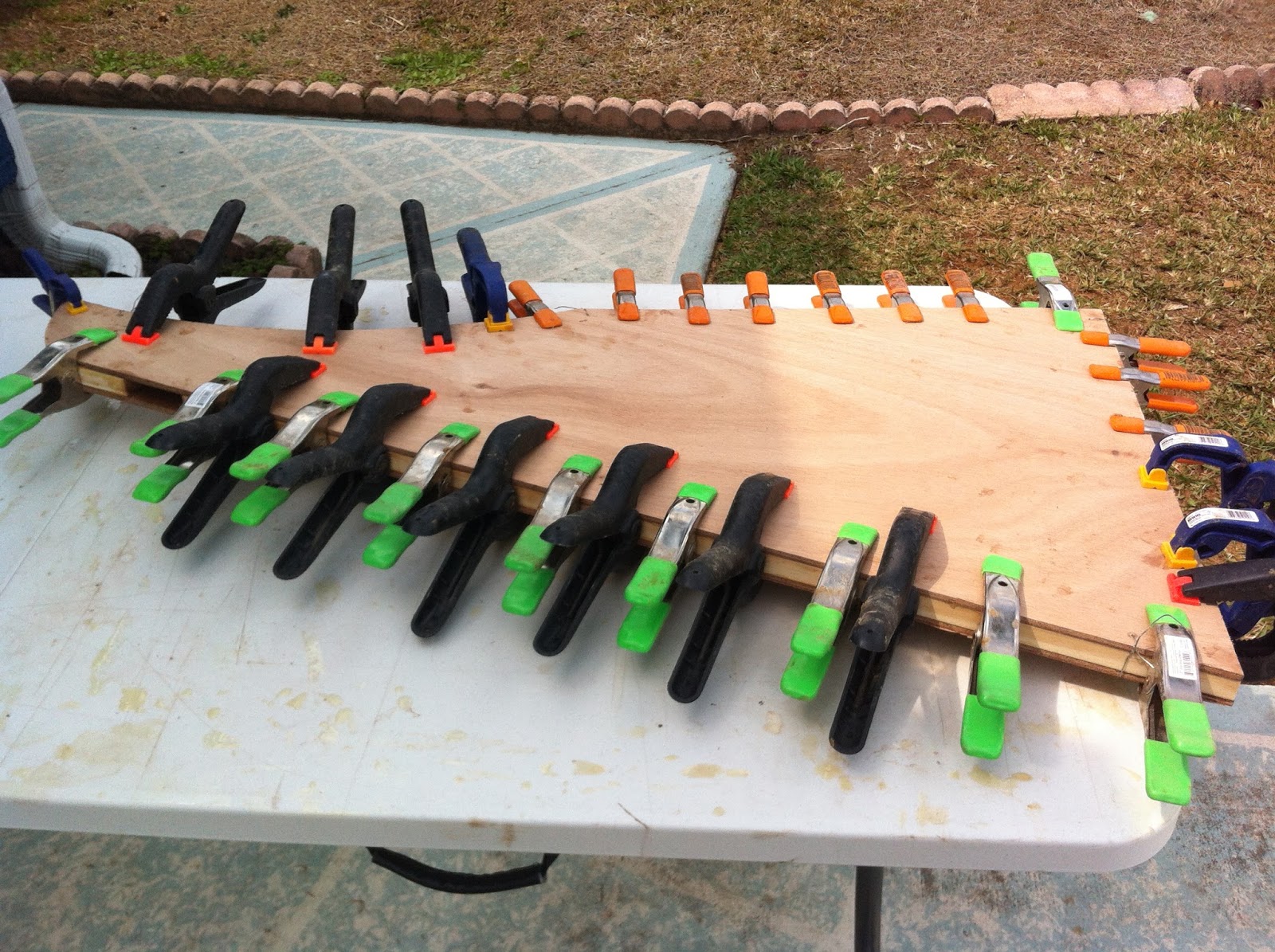

As you can see this thing need a lot of clamps.  I needs to be watertight when it's finished so pay close attention to the joints in the framing.  I had one that was a little open and when I checked to see if it was leaking (by blowing into it, I'm glad no one was around to see that), it was.  A little thickened epoxy fixed that.


The bottom plate adds authority to the rudders effectiveness and according to the manual acts as a makeshift re-boarding step.  I glued and screwed it on then checked for squareness.  I lucked out and it was dead on without any adjustment.  I used 4 screws to attach.  The manual only shows three but I put in four but what the heck, I splurged.


I feel like I'm really getting the hang of the woodworking (gee Bill, it's only taken you 2 years) and now I have many less "false starts" or "do overs" than I did when I first started building.

Next up, finishing the rudder.


Hours this session: 8
Total hours 490

Friday, March 22, 2013

Working Scared

In this installment of the never-ending build, I perform the scariest thing I've done such pouring lead.  That being cutting the hull for the dorades, hatches, and portholes.  You can't imagine my angst at setting a blade to that which I had spent so much time creating.  It ain't right.

Before I attempted this work I finished filling the weave on the fiberglass by adding 2 more coats of epoxy on the rub rail and everything above it.


Everyone has heard measure twice and cut once.  Well I must have measured this stuff about 8 times and I still didn't feel good when I grabbed my saw.  The first cuts I made were for the storage hatches.  I took one of the hatches and used it's base as a template.  The hardest part about this was holding it in place while I traced the opening.  The hatch would slide and I would have to start over.  It was difficult maneuvering the pencil around the corner between the seat back and the transom.  Eventually, I got them both marked correctly and cut out with the jig saw.  A follow up with the hatch showed that I got it about as perfect as I could expect.  Very snug fit.


The portholes were already scored for me.  I cut to the INSIDE of the scoring so that I would be sure that I wouldn't make a mistake I couldn't easily fix.  Doing that left about 1/8" of extra that needed to be removed around the outside edge.  I did this very gingerly with a Dremel tool and a sanding wheel.  I tested it with the precut plexiglass provided by CLC and found that although I'm very close to the right size they're still a little small and I need a few more passes with the Dremel to finish this up.


The dorade vents were a little easier.  They don't have to be perfect since the trim ring will hide any issues.  Test fit went well.


Moving on to the rudder.

Hours this session: 6
Total hours 482

Saturday, March 9, 2013

Companion Way Hood/Hatch Finished

I haven't stopped working but the progress has slowed a little bit.  Not because of anything except that I haven't had much free time lately.  Oh well, I don't have any target date for this to be finished so it doesn't really matter.


The hood is made out of black walnut on the sides and white oak on the front and pull.  Nice looking, but like it says in the manual it requires a little bit of woodworking.  There are bevels to plane to make it fit the top of the cabin correctly, curves to match, pulls to make and it all has to slide correctly when mounted on the boat.  It took me quite a bit of adjusting and screwing around to get it to look/act right.


The hatch is pretty much the same.  Sides of black walnut and the front, back and pull made from white oak.  Looks good now and I expect it will look a lot better when its all finished nicely.  I added the compass rose inlay to the top of the hatch.  It comes from CLC was easy and fun to do with great results.  A little expensive but very high quality veneer.


The tops and sides are fiberglassed.  It'll need two more coats of epoxy before final sanding.

Next up I need to cover the entire boat and the hood/hatch assembly with two more coats of epoxy so I can finally roll this thing over.

Hours this session: 8
Total hours 476

Monday, January 21, 2013

Rubrails, Companionway Sill and New Dog


The rubrails are made from black walnut.  Very brittle stuff and doesn't seem to want to bend very well.  The act of putting in the temporary screws for the first layer punched holes into the cabin.  These will have to be filled and then re-painted.


The first layer required steaming and bending.  The steam system (outlined in a previous post) was required to for each of the three lengths on each side to get a good bend.  Even then I broke one because I didn't move fast enough after I had removed it from the steamer.


The second layer only required steaming for the front section.  The rest I just soaked in the swimming pool overnight and they could make the less acute bends.  The final layer being thinner didn't require any steaming at all, just soaking.


The sill was an easier build than the rub rails.  They are milled out of white oak.


The sill frame needed to be beveled on the bottom to take into account the slope of the cabin roof.  The table saw made short work of this.


The corners needed to have a 45 degree bevel to make everything nice and strong.


The front of the sill turned out to be a little higher than the sides.  This is no problem as I will take care of it with a block plane.


Plenty of clamps hold the assembly in place while it dries.


In November 'Sassy' my dog 10 years died from cancer.  It was a sad day when I had to make the decision to put her down.  The family was missing having a pet and so was I.  A trip to the local pound and we were able to rescue 'Cocoa'.  A pretty, long legged mutt of unknown origins.  Like most pound dogs she seems very happy to have been adopted and is quickly bonding with the family.  She likes to be near me in the garage while I'm working on my boat.  She seems to like water so I think she may be first mate when I finally get this thing floating.

Hours this session: 18
Total hours 468

Monday, December 31, 2012

Top Sides Fiberglassing and Misc Woodwork

After finishing glassing the footwell I moved on to the cabin top and the remainder of the front.  This all was much easier work than the footwell (see last post).  It went quickly without any issues.


I chose to use one piece of fiberglass to wrap around the front of the boat to the opposite side.


I made some additions to the fiberglass schedule on the front of the cabin top.  Before continuing the fiberglass down over the front of the cabin top I added an additional layer of biaxial tape along the front edge.  This is in response to reports of separation at this join, especially with PocketShips that have a removable tabernacle as I am planning on employing.


I continued the front fiberglass over the inside edge of the bow.


Here is my table saw jig setup for cutting the 10:1 scarfs for the rub rail.  This jib worked immensely well at cutting perfect scarfs.  Took literally 10 minutes to build.


If you look at the stack of wood just to the left of the white PVC you sees all the consistent scarfs cut with the jig.  I chose to make the rub rails out of black walnut because I love the way it looks when varnished.  It has a deep brown/black color with lighter grain patterns.


The PVC pipe is my steaming box.  After a failed attempt as getting the walnut to bend around the bow I decided that I would steam bend it.  The PVC pipe is 7' long and has a brass nipple at one end to attach the steam generator.  I've already tested it and it should do the trick.


I also used the block walnut for the toe rails.  The bend needed here isn't as severe as at the bow.  I was able to achieve this bend with no problem.


Hours total: 450

Friday, December 21, 2012

Finished Cockpit Glassing

So 25 yds. of new fiberglass arrived on Tues.  Since everything was prepared I rolled out a length for the center of the cockpit including the foot well.  This was by far the most challenging fiberglassing I've done to date.


The geometry of the footwell in combination with the front of the cockpit and the transom makes for some interesting curves and bends.  I cut darts and overlaps where I thought it made sense and smoothed everything out.  Again, trying to get everything as close and as smooth as possible before mixing a drop of epoxy.


I started laying down the resin with the center of the footwell and worked my way out and up the sides.  I had to do this while sitting in the cockpit and trying to avoid disturbing the dry glass that was there.  This involved some pretty strange contortions where at times I was on one knee with a leg hanging out of the boat while leaning over the footwell.  I had a difficult time with getting out all the bubbles in the corners and to a lesser extend the bottom edges of the footwell.


From there I moved on to the forward center section of the cockpit right behind the companion way opening.  This being flat was much easer to do.

The rest of the area to be epoxied could be reached from outside the boat and also flat so it was much easier to do.

Upon inspecting the work I noticed that I still had some moderately sized bubbles and lifting in the corners and along the edges of the bottom of the footwell.  I went back and worked out as many of these as I could.


After about 2 hours (using slow hardener) I went back to check the work and some of the bubbles had returned (or I just missed them in the first place).  I put on a latex glove dipped my finger in alcohol and pushed these back down.  That did the trick for most of them.


After drying I noticed a few small bubbles that I will have to take care of and there will be some sanding in the corners to remove a few rough strands of glass.  But it is a step done.  From here out the glassing should be MUCH easier.


 Hours this session: 4
Hours total: 443

Wednesday, December 12, 2012

Glassing the Cockpit

After getting the cabin top glued down I went to work rounding everything off.  I did most of this work with a sanding block and 60 grit sandpaper.  It was pretty easy work.  I also did some filling of cracks, divots and holes that I incurred during the process of building.


I rolled out the last of the fiberglass that came in the kit.  I knew I was going to run out of this because I chose to fiberglass a lot of areas that aren't called for in the manual.  These included the bottoms of the seats and the bottoms of the foredeck and cabin top.  I ordered more from CLC.


I laid out the glass and cut darts to fit the corners.  Using a large "wallpaper brush"  I brushed and stretched the fabric.  Instead of using my normal roller and squeegee method I saturated the cloth using a cut-down chip brush to keep the fabric stretched out as much as possible while I was wetting it out.


For this round of fiberglassing I chose to use a technique that was outlined in a video I found at OffcenterHarbor.  This is a for-pay web site that has a lot of information about small wooden boats.  The video was one that shows how to fiberglass a stitch and glue kayak.  But the techniques that were demonstrated seemed like a method would also work for me.


In the end the technique worked nicely and I felt very much more in control of the wet-out process.  As I got better with it the technique the results improved the starboard side was done first.  The port side used noticeably less resin and I had less pooling as I learned the technique.  The final results on both sides were very good.  I actually look forward to do the cabin top and the bottom of the boat with the same technique.


The footwell and set centers will be done next.  I'm waiting for more fiberglass to arrive so that I can continue.


Hours this session: 10
Hours total: 439